Peeling is a symptom, not the root problem
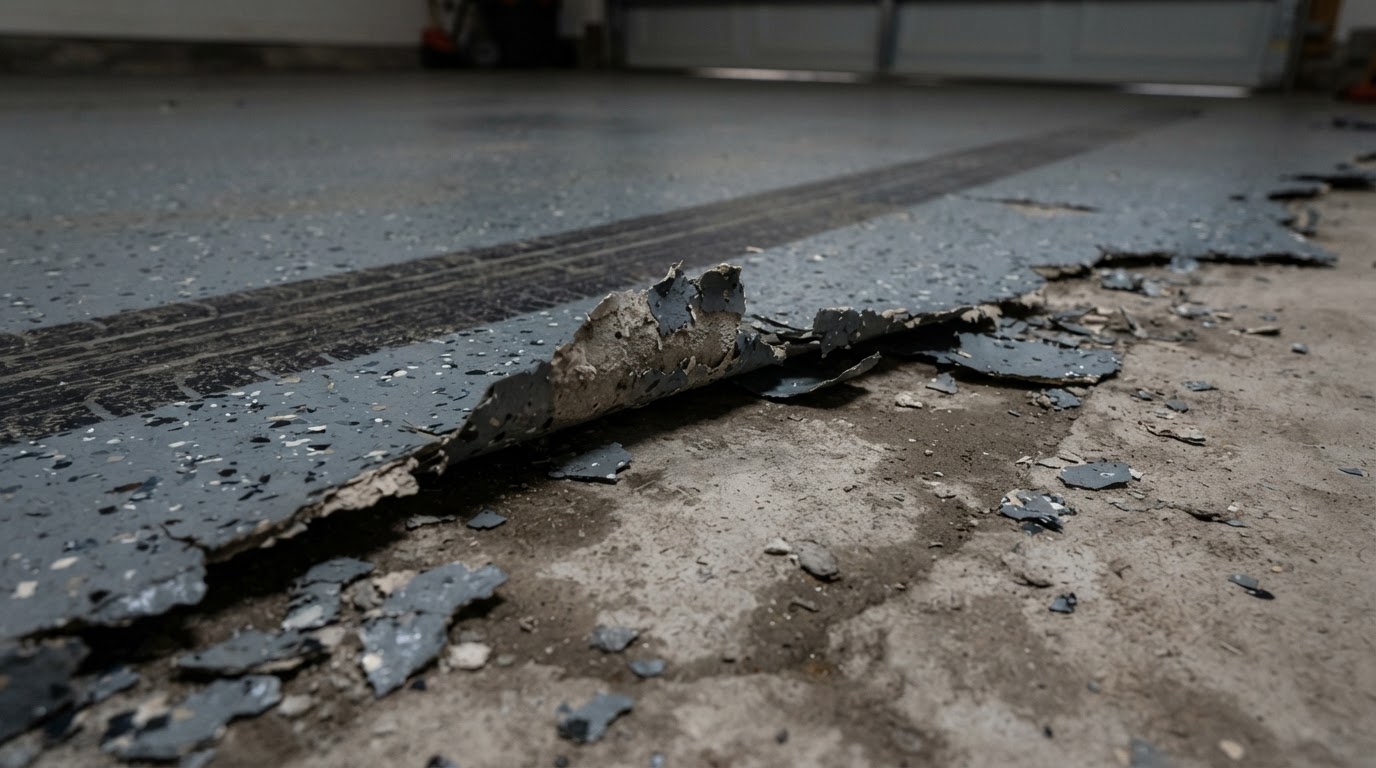
When an epoxy floor starts peeling, the coating is not really failing — it is revealing that something went wrong underneath it. Peeling is a symptom of a bond failure, and bond failures almost always trace back to surface preparation, contamination, or moisture. The coating is lifting because it never properly attached to the concrete in the first place.
Poor surface preparation
This is the number-one cause. If the concrete was not mechanically profiled — usually with diamond grinding — the coating sits on a smooth, weak, dusty surface instead of locking into open pores. Acid-etching, the method most DIY kits rely on, does not create the same mechanical bond. The result is a coating that looks fine until the first hot tire or temperature swing breaks the weak bond and lifts it.
Surface contamination
Oil, grease, tire shine, old sealer, and even a film of concrete dust between the coating and the slab all act as bond breakers. If contaminants are not fully removed before coating, the coating bonds to the contamination instead of the concrete — and peels off with it. Oil that has soaked deep into the slab is especially problematic because it cannot be cleaned from the surface alone.
Moisture
Concrete that is wicking up ground moisture pushes vapor upward through the slab. That moisture pressure builds under the coating and eventually forces it off, often as bubbling or blistering before full peeling. Basements and slabs without a vapor barrier are most at risk. Moisture has to be identified and addressed at the source before any coating will hold.
Improper concrete profile
Even when a floor is ground, the wrong profile causes problems. Too smooth and the coating has nothing to grip; too rough and the coating bridges over peaks, leaving thin spots that wear through and lift. A professional targets a specific CSP profile so the coating bonds evenly across the whole slab.
Application problems
Coating applied too thick can trap solvents that never fully cure, leaving a soft layer that delaminates. Applied too thin, it wears through to bare concrete. Mixing errors — wrong ratios, incomplete mixing, or working outside the product's temperature range — can also prevent proper cure and lead to peeling. Fast-curing systems like polyaspartic are unforgiving here: you get one shot to apply and broadcast before they set.
Incompatible materials
Coating over an existing coating, sealer, or paint that is not compatible with the new material is a common mistake. The new coating bonds to the old layer, and when the old layer fails, both come up together. The only reliable fix is to remove the old coating entirely and start on bare, profiled concrete.
How peeling floors are actually fixed
There is no shortcut: the failing coating has to come off completely. We diamond-grind the old coating down to bare concrete, profile the slab, repair any cracks or damage the peeling revealed, and check for moisture before applying a new system. Coating over peeling material just guarantees the new floor peels too.
If your floor is peeling, request a free estimate and we will tell you whether it can be salvaged or needs a full strip-and-recoat.
Get a Free Estimate for Your Floor
Reading is a start — let us come measure your actual slab and give you an honest quote. Free, no-pressure, on-site.